|
|
 |
|
|
|
Loren MazzaCane Connors:
an interview by Chris Rice. [Excerpted] |
|
LMC: As far as guitar goes, I started picking that up in the early sixties, around ‘64 or ‘63 maybe, because of the Beatles and Rolling Stones. And then around ‘66, I got in a band playing bass. I guess my present-day style evolved way back then. It came from the trombone, the slide sound. I kind of wanted to translate that over to the guitar. I didn’t really know about bottlenecks in those days. I had Muddy Waters’ records in the mid-sixties, ‘64 and ‘65, and I used to listen to them in my room and play on the bass, try to play the bass part. I guess the fingering style I have now came from playing bass. I was single-note oriented rather than chord-oriented. I continued with that up though the early ‘70s. I got an acoustic guitar and my sister showed me some chords. I started playing.
|
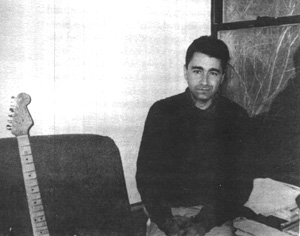
I was a painter in those days, and I’d play while I was looking at what I had done in painting and just fool around. I used to play in college coffee-houses. And when I was out in Cincinnati in the mid-70’s, I played with a piano player, a violin player and a saxophone player, and I had a little thing happening, with dancers and stuff. That’s how it all started, I guess. And then in the late ‘70s, I got more serious about music. I stopped doing visual art and sat down, started making tapes and dug into that sound I had developed as a kid, the slide sound, and went for it. |
|
LMC: My music is political. It’s always been political. My old drawing teacher used to tell me that my work was really political internally. It’s always been vocal and declaratory. So it’s no wonder that I’ve gotten into Irish history and New York history. There are a lot of tragedies that have been swept under the rug in modern life, about the nineteenth century, and maybe we ought to remember some of them so we won’t repeat them again, which we do anyway. To me there’s nothing like making a composition that really vocalizes something, that says something -- political or whatever you want to call it -- that declares that there’s a conflict going on among us and inside us and without us and within us. That is what life is all about, because without conflict there’s just nothing.
LMC: The way I make my records is, I will put down some chord material, a sequence, and then overdub leads and things onto it -- I build up pieces like that and then build up suites of pieces. Just about everything I’ve done has been on the four-track. And almost all my records have been recorded in my own house or art studio or wherever I was living. Only a couple have been done in a recording studio. I like to work in suites -- to tell a historical story, or a cityscape or a spirit suite, made up of pieces that all fit together in a way that works as a whole. Maybe twelve, thirteen, fifteen pieces all strung together to build a composition, so it works as a composition itself rather than just a collection of pieces.
For more information on Loren Mazzacane Connors: |